What is risk-based position sizing?
Risk-based position sizing means choosing your share quantity based on how much of your account you're willing to lose if the trade hits your stop loss. You decide the dollar risk first, then work backward to the number of shares.
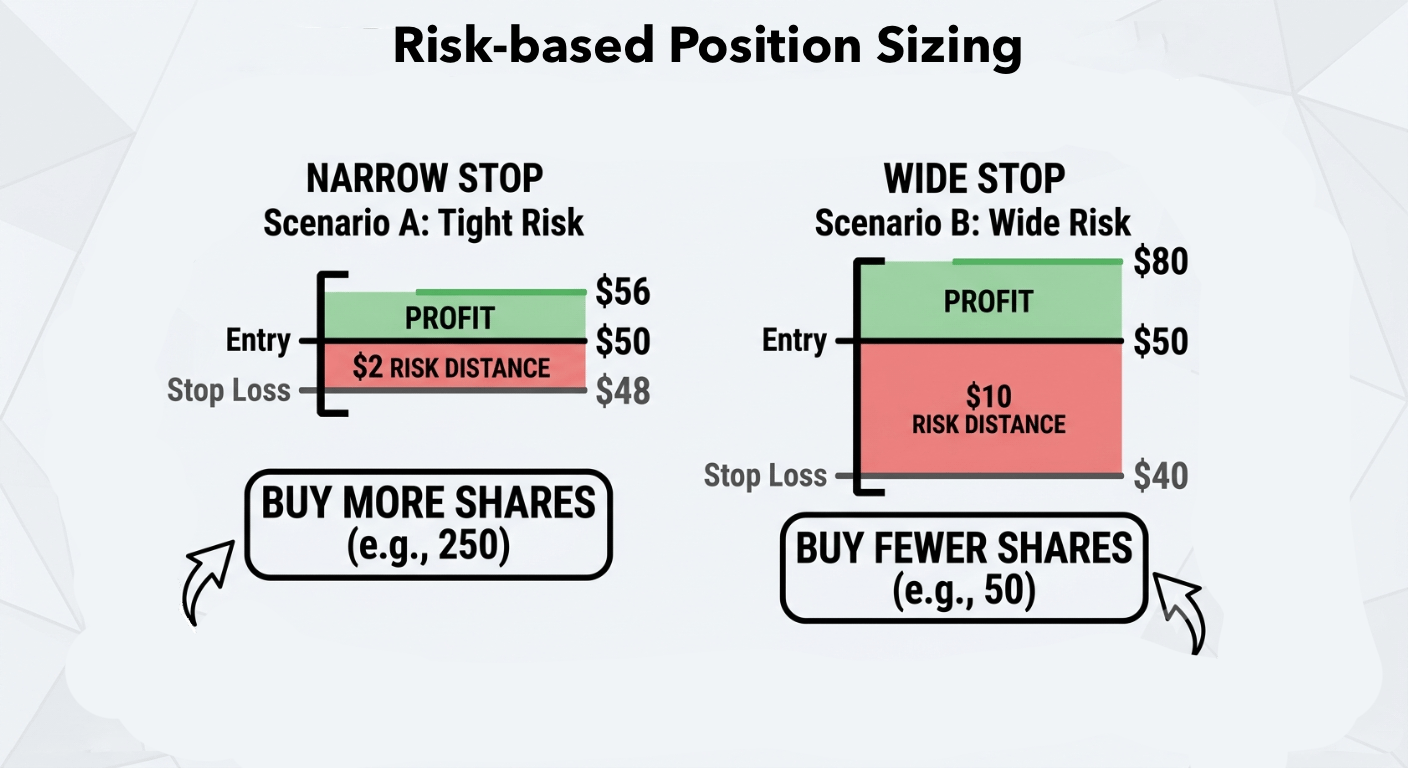
Most traders use the 1% rule: risk no more than 1% of your account per trade. If you have a $50,000 account, you risk $500 maximum. If your stop loss is $2 away from your entry, you buy 250 shares ($500 ÷ $2). If the stop is $1 away, you buy 500 shares.
The formula is straightforward:
Position size (shares) = Account risk ($) ÷ Distance to stop ($)
The hard part is not the math. The hard part is calculating it real-time as the stock price is moving. Even harder is sticking to it when you've just taken two losses in a row and want the money back.
Why traders break their own position sizing rules
When we built PrecisionTrader's position sizing engine, we assumed traders would set a risk percentage once and let the software calculate shares automatically. What we saw instead: traders would override the calculation manually about 40% of the time, and the overrides clustered heavily after losing trades.
The pattern is predictable. You lose on a trade. The next setup looks good, and your risk limit says you can only buy 50 shares. You think, "If I size up to 100 shares and it works, I'm back to breakeven!" You enter 100 shares. Now you're risking twice as much, and if this trade also loses, you're down even more.
This is not a knowledge problem. Every trader who does this knows the rule. It's an execution problem. Calculating the right size and actually entering that size are two different things, and the gap between them widens under pressure.
How to calculate position size step by step
Here's the process with real numbers.
Step 1: Decide your account risk percentage. Most day traders use 0.5% to 1%. Funded traders on prop accounts often use 0.25% to 0.5% because the daily loss limits are tighter. Let's say you're using 1%.
Step 2: Calculate dollar risk. If your account is $10,000 and you're risking 1%, your risk is $100 per trade.
Step 3: Identify your stop loss distance. You want to buy a stock at $50, and your stop is $48. The distance is $2.
Step 4: Divide dollar risk by stop distance.
$100 ÷ $2 = 50 shares
You buy 50 shares at $50. If the trade hits your stop at $48, you lose $100 (50 shares × $2 risk). That's exactly 1% of your account.
What if the stop is wider? Same entry at $50, but your stop is now $45 because the setup needs more room. Distance is $5.
$100 ÷ $5 = 20 shares
Your position size drops to 20 shares. Wider stops mean smaller positions if you want to keep risk constant. Traders who ignore this and size the same regardless of stop width are not using risk-based sizing; they're guessing.
The manual calculation problem (and how software fixes it)
You can calculate position size on paper, in a spreadsheet, or with a calculator. The issue is speed and emotion. You see a setup, you have maybe 10 seconds to decide, and your last trade just closed red. You're supposed to pause, measure the stop distance, divide your risk dollar amount, and enter the result. In practice, most traders round to a number that feels right or reuse the same size from the last trade.
This is where automated position sizing makes a difference. PrecisionTrader calculates your share count in real time as you drag your stop loss line on the chart. You set your risk percentage once in your account settings (say, 1%). When you place a bracket order, the platform reads your entry price, reads your stop price, calculates the distance, and fills in the share quantity automatically.
You can still override it manually, which is where enforce mode comes in. If you enable position size enforcement, the platform blocks orders that exceed your risk limit. You can't size up to 200 shares when your limit says 100. The order won't go through. That sounds restrictive until you look at your journal three months later and realize you stopped giving back your winners.
Common mistakes and how to avoid them
Risking the same dollar amount regardless of stop width. If you risk $500 on every trade but your stop distances vary from $0.25 to $2, your position sizes should vary by a factor of eight. If they don't, you're not doing risk-based sizing.
Using the same share count on every trade. This is the opposite problem. You always buy 100 shares because it's easy to remember. Some days your stop is tight and you're risking $300. Other days it's wide and you're risking $1,200. Your risk is all over the place.
Forgetting to account for partial exits. If you plan to sell half at your first target, your risk calculation should reflect that. Some traders calculate risk for the full position but forget they're exiting half early, which effectively cuts their planned risk reward.
Overriding the calculation after a loss. This is the big one. You know the right size. You calculate it, or your software calculates it for you. Then you change it because you want the last loss back. A rule you can override whenever you feel like it is not really a rule.
FAQ
What is the 1% risk rule in trading?
The 1% rule means you risk no more than 1% of your total account balance on any single trade. If you have a $50,000 account, you risk a maximum of $500 per trade. This limits drawdowns and keeps you in the game through losing streaks.
How do you calculate position size with a stop loss?
Divide your dollar risk by the distance to your stop loss in dollars. For example, if you're risking $500 and your stop is $0.50 away, you buy 1,000 shares ($500 ÷ $0.50). Wider stops require smaller positions to maintain the same risk.
Why do traders size their positions incorrectly?
Most traders know the formula but override it under pressure, especially after a losing trade. The calculation is easy; following it when you're down money and emotional is hard. This is why enforcement tools that block oversized orders help more than calculators alone.
Should funded traders use smaller risk percentages?
Yes. Most prop firms enforce strict daily loss limits (often 3-5% of the account). Funded traders typically risk 0.25% to 0.5% per trade to avoid hitting the daily limit after a few losses. Tighter risk per trade gives you more attempts before you're locked out.
Next step
PrecisionTrader calculates your position size automatically and enforces your risk limits so you can't override them mid-tilt. See how it works with a free 14-day trial.
Start Today