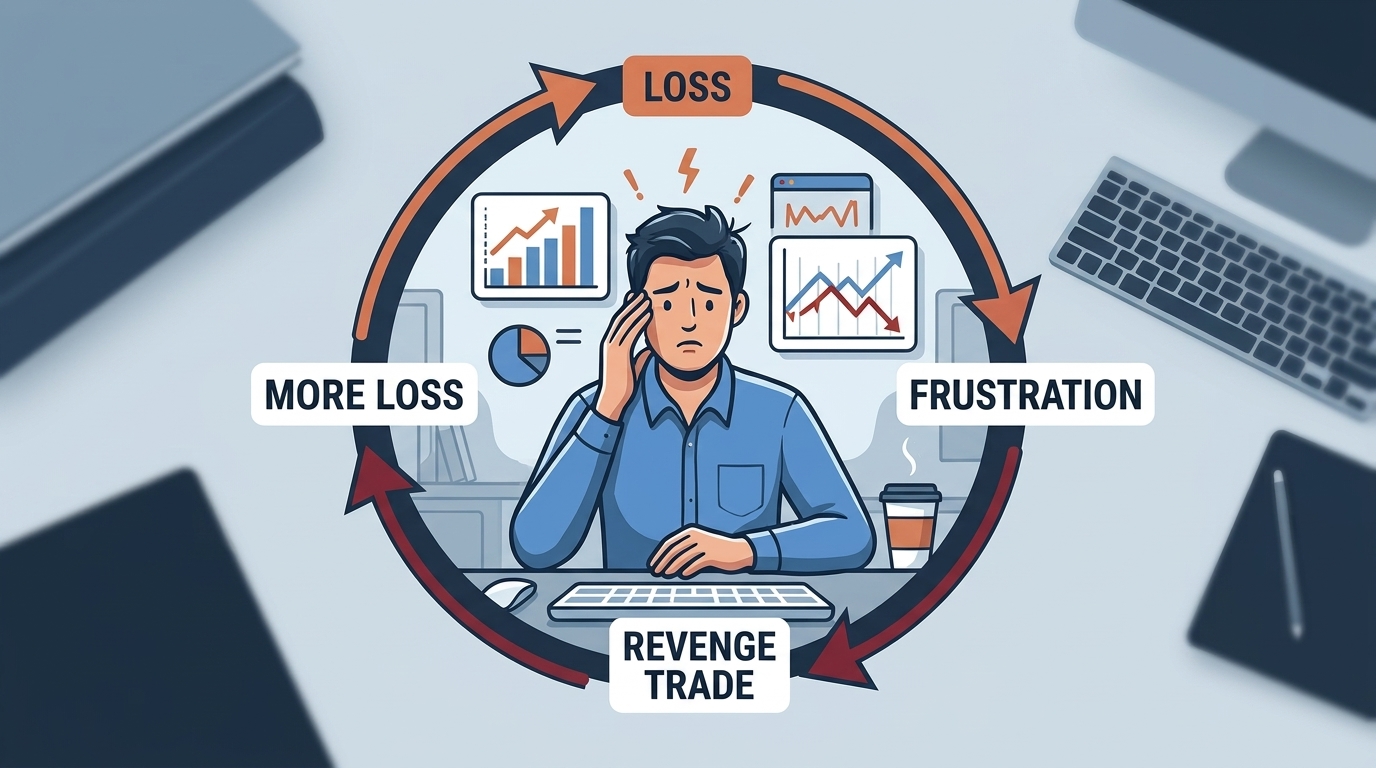
What is revenge trading?
Revenge trading is when you take another trade immediately after a loss to try to win back the money you just lost. The new trade is not part of your plan. It is usually larger than your standard position size, it ignores your setup criteria, and it happens fast.
The pattern is consistent: you lose, you feel angry or embarrassed, and within a few minutes you are back in the market with double the risk. When we built the rule enforcement system for PrecisionTrader, we found that most traders who override their daily loss limits do it within 10 minutes of hitting the limit. The gap between the loss and the next trade is where revenge trading lives.
Revenge trading is not about lacking discipline in some vague, character-flaw sense. It is about having a plan that only works when you are calm and a brain that stops being calm the moment you lose money.
Why do traders revenge trade?
Loss aversion is the short answer. Behavioral finance research shows that losses hurt roughly twice as much as equivalent gains feel good. A $500 loss does not feel like the opposite of a $500 win—it feels worse, and your brain wants to fix it right now.
The other piece is what psychologists call ego depletion. Making disciplined trading decisions all morning uses up your self-control reserves. By the time you take a bad loss, you have less capacity to stop yourself from doing the thing you know you should not do. You are tired, you are mad, and the market is still open.
Revenge trades also tend to work just often enough to reinforce the habit. If you double your position size and win, you feel like a genius. The times it blows up your account get rationalized as bad luck. The brain remembers the wins and downplays the losses, so the loop continues.
Step 1: Set a hard daily loss limit and enforce it automatically
A loss limit you can break is not a limit, it is a suggestion. Most traders set one in a spreadsheet or a journal and then override it the moment it matters.
The step that works is making the limit unbreakable. If your platform can lock you out after a certain dollar loss, turn that feature on. If it cannot, you need to close the platform yourself the moment you hit the number, which is harder but still possible if you decide in advance that hitting the limit means you are done for the day—no exceptions, no rationalizations.
For prop firm traders, this is not optional. Most firms have daily drawdown limits that will fail you if you break them. Treating your personal account with the same hard stop is what keeps you from turning a bad morning into a career-ending afternoon.
PrecisionTrader's enforce mode does this automatically: when you hit your daily loss limit, the platform blocks new orders. You can still close positions, but you cannot revenge trade your way deeper into a hole. The feature exists because we watched too many traders write "I will stop at $X" in their journal and then ignore it 10 minutes later.
Step 2: Build in a mandatory waiting period after any loss
The second step is time. Do not take another trade for at least 15 minutes after a losing trade. If the loss was large or emotional, make it 30 minutes or an hour.
This is not about calming down in some meditative sense. It is about letting the acute emotional spike pass. The revenge-trading impulse is strongest in the first few minutes after a loss. If you can get past that window without placing another order, the odds of a rational decision go up significantly.
Some traders set a timer. Some step away from the desk entirely. The mechanism matters less than the gap itself. Fifteen minutes gives your brain time to stop screaming and start thinking.
If you are using a platform that tracks this, even better. Knowing the software is watching makes it easier to follow through. If not, write the rule down and test yourself on it: "No trade for 15 minutes after a loss, no matter what I see in the chart."
Step 3: Journal immediately after the loss, before the next trade
Write down what happened before you do anything else. What was the trade, why did you take it, what went wrong, and how do you feel right now.
The act of writing interrupts the emotional loop. It also creates a record you can review later. When you look back at a week of trades, the revenge trades are obvious—they are the ones with no journal entry or a one-line excuse written after the fact.
The journal does not have to be long. Three sentences is enough: what you did, why it did not work, what you are feeling. The point is to acknowledge the loss explicitly instead of trying to erase it with the next trade.
Automatic journaling helps here because it removes the friction. If your platform logs every trade and prompts you to add notes immediately after you close the position, you are more likely to actually do it. Manual journaling works too, but it requires more discipline at the exact moment your discipline is lowest.
Step 4: Review your revenge trading patterns with data
Revenge trading follows patterns, and those patterns show up in your trade data. Most traders who revenge trade do it at the same time of day, after the same type of loss, or in the same market conditions.
Pull up your last 50 trades and filter for the ones that happened within 10 minutes of a losing trade. Look at the position size, the setup quality, and the outcome. If those trades are larger, looser, and more likely to lose than your average trade, you have a revenge trading problem.
The benefit of data is that it removes the argument. You are not guessing whether you have an issue—you can see it. You can also see whether the steps you have taken are working. If you set a mandatory waiting period two weeks ago, do you have fewer revenge trades now than you did before?
Some platforms surface this automatically with behavioral analytics. If yours does not, you can build a simple spreadsheet that flags any trade taken within 15 minutes of a loss and calculates the average outcome for that subset versus your other trades.
FAQ
How do I know if I'm revenge trading or just taking another valid setup?
Check the time gap and the position size. If the trade happens within 10 minutes of a loss and the size is larger than your usual risk, it's probably revenge trading. A valid setup follows your plan, matches your normal risk parameters, and does not feel urgent or emotional.
Can I ever take another trade after a loss the same day?
Yes, if it is part of your plan and you have waited long enough for the emotional spike to pass. The issue is not trading after a loss—it is trading immediately after a loss with larger size and looser criteria to try to win the money back.
What if I hit my daily loss limit early in the session?
You are done for the day. Close the platform, step away from the desk, and do something else. The market will be open tomorrow. Trying to trade your way out of a hole is how small losses become account-ending losses, especially for prop firm traders.
How long should I wait before trading again after a big loss?
At least 15 to 30 minutes for any loss. For a large or emotional loss, consider waiting an hour or until the next trading session. The goal is to let the acute emotional reaction fade before you make another risk decision.
Next step
PrecisionTrader enforces your daily loss limit automatically and tracks your trade timing so you can see exactly when and how often you break your own rules. Start your free 14-day trial—no credit card required.
Start Today