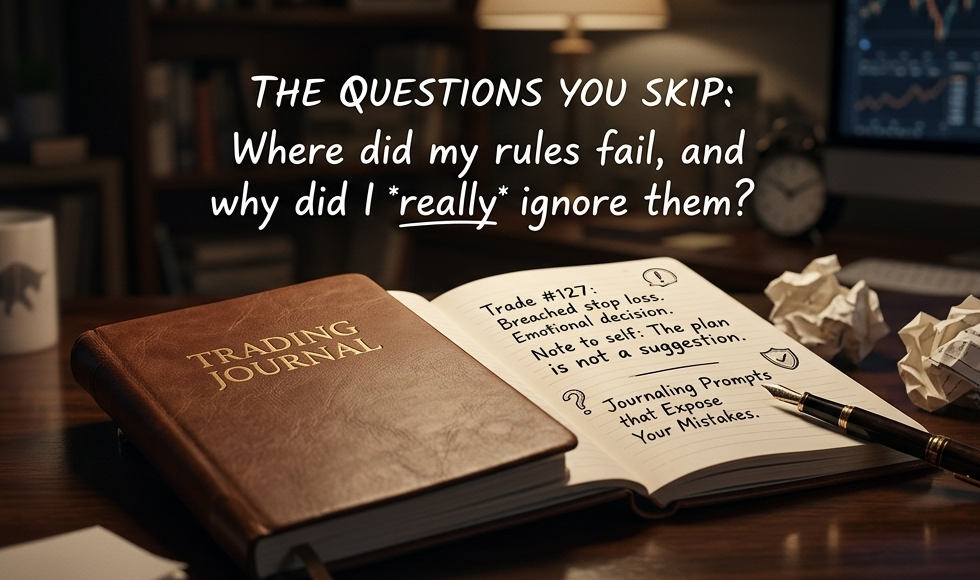
The journaling problem no one talks about
Most traders know they should journal. Fewer actually do it. The ones who do often fill it with facts (entry, exit, P&L) and skip the uncomfortable part: why they ignored their own plan.
A good journal prompt does not ask what happened. It asks why you did what you did, especially if you knew better. The traders who improve are the ones who answer the second question honestly.
The prompts below are short and focused on one thing: exposing the gap between your rules and your actual trading behavior. If a prompt makes you want to skip it, it might be the one you need to answer.
Before the trade: intention prompts
What is my max loss on this trade, in dollars?
Not a percentage. A number. If you cannot answer this before you enter, you are already guessing.
What will I do if the trade moves against me in the first two minutes?
Most traders have a vague plan ("I'll reassess"). A real plan is a specific action: exit at X price, add a stop, or do nothing and wait for the first target. Write it down before the trade keeps playing out.
Why am I taking this trade right now?
If the honest answer is "I've been sitting here for an hour and I'm bored," you have your answer. Boredom is not a setup.
After the trade: the questions traders skip
This is where most journals turn into scorecards. The trade either made money ("good trade") or lost money ("bad luck"). Neither of those is useful.
Did I follow my own rules on this trade?
Yes or no. If no, which rule did you break and at what point in the trade? Be specific. "I got emotional" is not an answer. "I moved my stop after the first rejection because I thought the level would hold" is an answer.
What was I feeling right before I broke the rule?
This is the one traders skip. The feeling matters because it is the early warning system. If you felt anxious and then oversized, that is the tell. If you felt frustrated after two losses and then revenge traded, that is the pattern.
If I could rewind to 30 seconds before I made the mistake, what would I tell myself?
Not what you should have done. What you needed to hear in that moment to stop yourself. That sentence is your real rule, not the one you wrote in your plan.
Would I take this exact trade again with the same information?
Ignore the result. If you lost money but followed your edge, the answer is yes. If you made money on a chase, the answer is no. This prompt separates process from outcome.
End of week: pattern prompts
Daily journaling captures the trade. Weekly review captures the pattern.
Which rule did I break most often this week?
If you broke the same rule three times, that rule is not working as written. Either the rule is wrong for your strategy or you need a system that enforces it, not just tracks it.
What was my emotional state on my worst trade?
Worst trade means the one where you deviated most from your process, not the one that lost the most money. If your worst trades cluster around the same feeling (impatience, revenge, overconfidence), that is your leak.
Did I trade when I said I wouldn't?
Outside your hours, after hitting your daily loss limit, or during news you planned to avoid. If yes, what triggered it? The trigger is more important than the trade.
How PrecisionTrader handles journal prompts
PrecisionTrader's journal captures trade data automatically (entry, exit, size, P&L) so you do not have to log mechanics. The prompts focus entirely on the decision: what you planned, what you did, and why you deviated.
After each trade, you answer a short set of prompts (customizable). PrecisionAI then analyzes your answers over time and surfaces patterns you would not see in a single entry: which rules you break most often, which emotional states precede your worst trades, and where your process is leaking money.
If you are filling out a journal and still breaking the same rules every week, the issue is not the journal. You need a system that enforces the rules before you break them, not one that documents the damage after.
That is what enforce mode does: it blocks the trade if it violates your preset limits, no override.
Start a free 14-day trial and see which rules you've been breaking.
FAQ
What should I write in my trading journal every day?
Log your plan before the trade (setup, max loss, exit rule), then answer whether you followed it and what you were feeling when you deviated. Focus on decisions, not just results. The goal is to find patterns in when and why you break your own rules.
How long should a trading journal entry be?
Two to three sentences per prompt is enough. You are not writing an essay. The journal is useful when it is honest and specific, not when it is long. If the entry takes more than two minutes, you are overthinking it or avoiding the real question.
What is the most important trading journal question?
Did I follow my own rules on this trade? If no, which rule did I break and what was I feeling right before I broke it? That question exposes the gap between knowing your plan and actually following it, which is where most traders lose money.
Should I journal winning trades or only losing trades?
Journal both. A winning trade where you broke your rules is a problem, not a success. A losing trade where you followed your edge is fine. The journal's job is to separate process from outcome so you can see which behaviors actually cost you money over time.